The following article was published on
CountyLive.ca on December 9th, 2011
Upbeat attitude makes life better for woman and her best friend by Margaret Haylock Capon
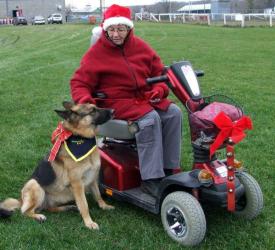
When Gay Halpenny adopted an unsocialized two-year-old named Judy, her family and friends were annoyed with her.
"They asked me what I was doing, but I felt I could do this," says the Picton resident who has successfully proven that a woman with multiple sclerosis and a German Shepherd who spent her early life in a kennel can become a winning team.
Today, Gay and Judy are members of the Winstead Synchronized Walking Team and regular students in obedience and agility classes at Winstead Dogs. Their success story is an inspiration to fellow team members, for Gay, who enjoys a close bond with her dog, pilots her from her motorized scooter.
Gay recalls that Judy was two years old when she bought her from a breeder in Orangeville. She had spent the first year of her life in a kennel and was not well socialized.
"When I got her, she was not too used to people. I had to take her to school. She attached herself to me very quickly and became over-protective of me. She didn’t like visitors and barked when they came to the door. I had to do something or I couldn’t keep her."
For a time, Gay worked with Judy under the guidance of her breeder in Orangeville but the distance involved eventually made this impractical.
"I found Ken Campbell at Winstead Dogs (near Bloomfield) and started in basic obedience. Ken felt that Judy had so much potential and I just needed to work with her."
Gay, who used a cane in class, sometimes felt that she could not do the work required to train her dog.
"I have MS and it was taking too much energy," she says.
Although she sometimes found it difficult, she persevered and progressed to agility classes with Judy, when Campbell suggested that basic obedience work was no longer needed. "She walked with me and my walker. Ken felt I needed a connection with her and agility work would help with this. Judy would learn to have fun. It really does give you a better connection. You pay attention to each other."
Initially, Gay used her cane when taking her dog over the agility course, but soon developed discomfort in her leg and neck. She realized that she was trying to move faster than usual and throwing her body out of line, in an effort to keep up with her dog.
"I switched to using my walker and relaxed more," she says.
"Ken’s guidance kept me going. He told me my dog had to adjust to my gait. I relaxed more and my problems resolved. Judy has changed quite a bit. She does pay attention now and slows down."
"The walking team was another challenge," says Gay, referring to her participation in the Winstead Dogs Synchronized Walking Team.
When Gay found that she could not keep pace with other team members while using her walker, she decided to ride her scooter instead. Judy readily accepted this change and obediently walked beside her owner, during practice sessions.
Unfortunately, Gay’s scooter malfunctioned, just before the start of last weekend’s Picton Santa Claus Parade and she and Judy were unable to take their position at the head of the walking team. Campbell and Janice Hanthorn of Winstead Dogs, swiftly improvised. Gay rode on the tailgate of their Jeep with Judy walking behind it.
Gay and Judy’s fellow team members regard them as an inspiration. "I hope we are an inspiration," says Gay, "for others who have gone before have inspired me. You see young people (with disabilities) out there trying to make a good life and it’s inspiring."
"It (participation in dog school classes) helps me physically. I would not be doing any of this on my own. Judy can run like the wind and I try to take her for a run, once or twice a week. She won’t run, unless I walk and I can walk for up to an hour," says Gay, observing that Judy’s runs are good exercise for her, too.
"I can’t imagine my life without a dog," says Gay, who has owned German Shepherds for more than 40 years.
"I don’t know if I was stubborn or what, but I said I could do this," she adds, referring to her decision to train Judy.
She admits there were times when she wanted to give up, but Campbell guided her through them and today, she and Judy have a strong partnership. They have become a team.
Campbell says,"Gay first came to Winstead Dogs for guidance in managing Judy’s territorial issues. Gay and Judy’s education included basic obedience followed up with some agility classes. Both courses taught Judy that Gay was her partner and leader. Gay’s determination to overcome her physical challenges and build a strong partnership with Judy is an inspiration to all".
"It was extremely disappointing that Gay’s electric scooter failed on parade day, so she was unable to demonstrate the teamwork that they have achieved, however, they still didn’t quit. Judy walked the parade route, while Gay rode in a vehicle, encouraging Judy along the way! Winstead Dogs is very proud of all the dogs and their handlers who joined in the fun of the Picton Santa Claus Parade".
The following article was published in The Intelligencer on July 25th, 2010 (Article ID# 2672765)
Dogs dubbed good neighbours
Prince Edward County
PICTON — Eleven dogs here have been officially dubbed "good neighbours."
The Canadian Kennel Club (CKC) Canine Good Neighbour program identifies and rewards responsible and caring owners and their canine partners. A recent certification session was held at a public park in Picton.
"I think the program was an absolute success, as all dogs in attendance passed all tests. I wish to extend my heartfelt thanks to the sponsors, as it was only with their support and help that we were able to present this evaluation day and raise $218. for the Lions' Foundation of Canada Dog Guides," said evaluator Ken Campbell of Winstead Dogs.
"The Canine Good Neighbour Program requires dedication on the part of the handler, to teach the dog proper manners in day-to-day activities. The rewards were clear to see, with the success of each dog and handler team and the smiles on their faces."
Successful participants in last week's program, which featured 12 separate tests were Inge Basler with Kaapi, Sue Dunstan with Dudley, Maggie Haylock with Snickers and Furby, Joanne Hnatuik with Cedar, Wendy McCullough with Ethan, Janice Mulroney with Suri, Jeannie Peruzzi with Jackson, Bernadette Storms with Kahlua, Bonnie Taylor with Holden and Janet Wager with Dot.
Sponsors for the event were BMO Nesbitt Burns, Randy and Joanne Coker, financial advisors; Winstead Dogs Training and Boarding and Canadian Tire, Picton.
The CKC will issue certificates for all dogs that passed the Canine Good Neighbour tests. There is no requirement for a dog to be a purebred, in order to participate in the program. Certificates are provided by the CKC for mixed breeds, as well.
Canine Good Neighbour tests are organized by local dog clubs, private dog training schools, pet therapy societies, community colleges, service organizations, pet supply stores and, in some instances, veterinary clinics. Evaluators are required to participate in training sessions before attaining evaluator status. Additionally, they must pass a written examination.
Campbell says another Canine Good Neighbour testing program will be held, locally, in August. A date has not yet been chosen.
The following article was published in The County Weekly News on April 2010 (Article ID# 1631680)
By Margaret Haylock Capon
With the dog days of summer swiftly approaching, bite incidents are on the rise says trainer Ken Campbell of Winstead Dogs.
Recognized as an canine behaviouralist by the public board of health for the City of Toronto, the Bloomfield area obedience and agility trainer says many dog bites could be prevented, with the observance of a few common sense rules.
He observes that bites, frequently, occur when individuals attempt to pet a strange dog that has been left tied outside a Main Street store, or inside a vehicle with open windows.
"If you walk up to a dog and say, 'Oh what a sweet dog, make eye contact, and stretch out your hand, your conformation changes to an unnatural position for a human. Dogs see silhouettes and when you change your silhouette, they recognize it," explains Campbell, noting that eye contact is perceived by the dog as an act of dominance.
"If a dog has been left tied to a parking meter, the owner has made the assumption that it will not bite. If someone walks up and contradicts the dog's image of the correct environment, it may bite. Don't walk up to a strange dog. Skirt it and if it sniffs, don't put your hand out. A lot of people treat train and the dog may smell your lunch, if you have the scent of food on your hand and it is downwind from you. It could lunge for you (assuming there is food in the hand)".
"Nobody knows when a dog will bite and anybody who tells you that their dog won't bite doesn't know their dog. You just need the right circumstances."
"When was the last time you walked down street and snuggled up to someone you didn't know, then spanked them on the behind as you left? Proper etiquette should be accorded to dogs, too", Campbell stresses.
He says bites, sometimes, occur when strangers attempt to pet or feed dogs left in vehicles with open windows.
"The vehicle is a safe haven for dog and owner. The dog assumes responsibility for it when the owner is absent. If a dog is sleeping in a vehicle, or if it is barking, do not stick your hand in to pet it."
"If you are going shopping, in the summer, don't take your dog and leave it in your vehicle, with the windows down. You never know when someone will reach inside."
The trainer adds that a barking dog or dogs in a compound never should be approached. They are protecting their territory.
Stray dogs or family pets running at large should never be approached. Call animal control, if there is concern about the animal's welfare, Campbell advises.
With the arrival of warm weather, an increasing number of dog owners are walking their pets in public places.
"Don't let your dog go nose-to-nose to meet and greet a strange dog. You are asking for a potential dog fight," Campbell warns.
"Dog owners need to be responsible and maintain their dogs in a manner in which they can control them. When off their own property, dogs should be leashed."
Campbell emphasizes that when two dog owners meet, while walking their pets, to avoid potential conflict, they should pass, handler-to-handler, never dog-to-dog.
Owners of small dogs should never pick up their pets, to avoid a fight.
"Don't pick up your dog. You change the fight to your arms. You constrain your dog and it fights to get out of your hands and the level of the fight is now at your face. Your body door changes, under stress, and your dog senses the need to protect you," says Campbell, observing that, in such incidents, dog owners can be bitten, through misguided attempts to protect their pets.
Campbell also cautions against the negative behaviour dogs can learn, when exercising at a dog park.
"A dog park is a fenced compound where dogs meet other dogs and learn habits from them. If your dog meets an aggressive dog, stands his ground and wins, it takes that learning back to you," the trainer says, observing the dog may then become assertive with its owner.
"Most aggressive dogs learn from other dogs. Even two dogs in the same household may fight. All it takes is an incident that causes one to challenge the other, unless there is a clear leader. You should always manage your pets so there is no aggression."
Campbell says when play between dogs becomes " even slightly mouthy", it should be halted, immediately.
The trainer notes that when dog owners walk their pets in public places, it is common for strangers to ask if they may pet them. He suggests that the answer should be a polite 'My dog is in training. I'd rather you didn't."
He points out that, today, there is zero tolerance for dog bites. If a dog inflicts even a minor bite, it must be reported. The report leads to quarantine and, potentially, a muzzle order.
Campbell says once a muzzle order is issued in the city of Toronto, the muzzle cannot be removed within the city to permit behavioural testing. Dogs that have inflicted bites may be sent to his kennels for assessment. After evaluating each one, he files a report to the board of health. A favourable assessment can lead to revocation of a lifetime muzzle order.
Campbell, a former police dog trainer and handler, has been described as Prince Edward County's dog whisperer, Dr. Phil for dogs, and an expert in dog-speak. Knowledge of safety practices to protect both dog and handler are an important part of the training he provides to students at Winstead Dogs.
The following article was published in The County Weekly News on October 29th 2009 (Article ID# 2152370)
Fostering dogs
By Margaret Haylock Capon
The participation of dogs from Winstead
Farm, in this year's Purina Walk for Dog Guides made all the
difference says Ameliasburgh's Janet Marissen, who fosters
prospective dog guide candidates.
Supported by the Wellington Lions Club. the walk, which took
place last weekend, during the village's Pumpkinfest Parade,
raised more than $3,300. One-third of this amount came in
pledges and donations from students at Winstead Dogs.
"It was wonderful to have Ken's (Ken Campbell, Winstead Dogs
owner and trainer) support this year,"Marissen says, noting that
Campbell encouraged his students to take part in the
annual event.
A total of 22 dogs and their owners walked in the parade, 12
of them from Winstead Dogs.
Marissen, today an Ameliasburgh resident, says she became
involved in fostering potential guide dog candidates, while
living in Belleville. She and her husband were active with the
Belleville Lions Club and, after moving to Prince Edward County,
renewed their involvement through the Wellington Lions Club.
Marissen has been fostering dogs for the past ten years and says
the fostering program has been operating in Canada, for the past
18 years.
"The Lions have their own breeding program and many breeders
will donate one or two puppies to them," she says.
Marissen notes that it is not necessary for dog guides to be
purebreds, if they are of the right temperament.
When dog guides complete their training, each is worth from
$20,000. to $30,000. They are given, at no charge, to
individuals who need them. Their new owners are responsible for
their care and well-being.
"Dogs for seizure victims and those with medical disabilities
are more valuable. There are dogs for the deaf, today, and there
is a new program for dogs for kids with autism," says Marissen.
"The dogs really do like to work," she adds.
In addition to the money raised through the recent Dog Guide
Walk, Marissen says the Lions have raised funds by volunteering
for Stoop and Scoop at the recent Belleville and District Kennel
Club show in Belleville. Photographs with Santa will be taken,
later this year, as another fundraiser.
Retired Teachers of Ontario, District 19,
recently supplied a grant for production of a book that tells
the story of the fostering and training of Dog Guide puppies.
"Lynn Pickering donated her time to write it and the book is
owned by the Lions' Foundation," says Marissen, who is now
providing copies to all local libraries.
"It's a children's book called Ash and Mrs. Hemingway," she
adds.
Marissen, says Roblin, the Standard Poodle that she has
been fostering now has been chosen for the dog guide breeding
program. She confesses that it is difficult to say goodbye to
the dogs who come into her care.
"Whenever people come up to me and say that they like my dog,
I tell them that it's not mine," she says, observing that
she always remembers she is only a "foster parent".
Marissen is a member of the Wellington Lions Club, chair of
the Walk for Dog Guides and foster parent to dog guides in
training.
The following article was published in The Picton Gazette on August 27th, 2008
Boot camp and holidays for dogs
Ken Campbell loves dogs. He believes there are no bad dogs, only bad handling.
An ex-police officer, he has been training and working with police dogs and service dogs all
over Canada for more than 30 years. Now he owns and runs Winstead Dogs, An ex-police officer, he has been training and working with police dogs and service dogs all
over Canada for more than 30 years. Now he owns and runs Winstead Dogs, a full service dog boarding and training facility on Gilead Road, Bloomfield
licensed to board up to 24 dogs. It's a combination day care, boot camp and holiday accommodation for dogs that also offers activity, agility and obedience
classes, tracker dog training and serious problem correction.
Economic development officer Dan Taylor sees it as another great county service.
"Pet owners can enjoy a day out or a longer stay at a hotel or bed and breakfast without worrying about their dogs being far away."
Campbell has spotted that market, and lets county vets and accommodations know what he has to offer.
"Business has grown steadily", he says, "I've hired one full-time employee, but I don't need to keep expanding. I have the best
life in the world. I run the dogs, clean the kennels, cut the grass, paint the fences, run the dogs some more. 'I'm happy.' He's as
good with people as he is with dogs and has quickly built a loyal customer base, both local and visitors. His business motto is
"Making Owners Happy, One Dog at a Time."
He's a specialist in problem correction using dog-to-dog communication methods and an expert witness on dog behaviour. Campbell talks to dogs the way they talk to each other: with body language. He never uses choke collars or treats in training.
Profiling People, Enterprise and Creativity at Work
Jan Davis
"If you're relying on treats or force you're not really communicating with your dog", he says. "You won't see what he's capable of, or smart she is."
Campbell is adamant that dog owners should understand they are 100 per cent responsible for an animal with primitive
instincts. Happily, one of those instincts is to defer to and obey the top dog.
Campbell explains why you have to dominate your dog and teaches you how to do it. "Training owners is more of a challenge
than training dogs," he says with a grin. The neat little
video clip on his web site (winsteaddogs.com) gives a a taste
of his approach to his work.
Winstead Farm has acres of well-kept grass fields divided by white fences plus a 7,200 square foot indoor arena, protected from
wind and weather in winter and ventilated by huge screened doors in summer.
Kennels in the barn are of varying sizes, all with thick, hygienic rubber matting. There ,were 13 dogs staying with Campbell
when we visited, and more , coming for the weekend. Not all were on vacation. One wiry little terrier was there because his
owner was rushed to hospital.
As trainer and owner, Campbell has rescued many dogs by undoing damage inflicted by unkind or unthinking
owners. His own two dogs are Jack, a huge St. Bernard, and Jake, a shepherd with a lot of baggage: both labeled uncontrollable and dangerous
until Campbell "fixed" them. Jake will never be mellow but he behaves for his master, and Ken is proud of him.
Campbell is generous with knowledge and advice. He made this writer feel better about her
Labrador's behaviour. He's especially
keen to help start new dogs off right and to help end "recycling" of dogs who cause problems, are given to shelters, adopted,
cause problems, and are dumped in a shelter again. He says it's all so avoidable. "It's because nobody takes control. Dogs expect and need to be controlled.
When you bring a new dog into your house you have to help him leave his baggage behind and understand he's in your den now. It's your rules."
Campbell offers an hour-and a-half of free training once a month, open to anyone. It's an introduction to the methods of a man who feels he's found the
good life in Prince Edward County. Campbell radiates calm, positive energy which may help to explain how he can get Shih Tzu's and Rottweiler's to listen to him,
look him in the eye and understand what he's telling them.
And the boarders? "Most dogs are happy to chill out, relax, take it easy. You can almost feel it with some of the dogs," he says.
"It's like 'ahhhhh, nice to have a break."'
This monthly column is brought to you by the economic development office, in recognition of local success stories and entrepreneurs.